
As a cusp Gen Xer/Millennial, I’d consider myself partially raised by pop culture (no offense, Mom and Dad, we all wanted our MTV). I fully embraced tech in the late ’90s and early 2000s, where the internet felt like a weird new universe to explore. It’s never been threatening to me, least of all my career. Even if I was using a computer to design things, they were MY things that I thought of with my own brain.
AI is a different story.
AI has always equaled BAD in pop culture and film. It signaled the end of humanity (“Terminator 2”, 1991), the end of Earth (“WALL-E”, 2008) and people dating operating systems (“Her”, 2013). Once an impossible reality, it’s unapologetically here. And whether it’s going to kill us, make us obsolete or be our next Tinder swipe, my GenX brain tells me that at the very least, it’s got a big branding problem.
Regardless of all that, I consider myself a realist, and I get the “adapt or die” world we live in. I’ll admit I’ve wanted to clone myself more than a couple of times. However, if you’re thinking of replacing a design team with AI agents, I pose these four ethical questions.
Question #1 – What is “design”?
To me, design has always been human. It requires talent, elite problem-solving skills and the courage to be judged daily. Effective creative drives billions of dollars in revenue. And yet, it’s been devalued by quick-fix tools, DIY platforms and $50 Fiverr logos. I’ve heard it called “advanced scrapbooking”*. It’s been absorbed into titles (marketing coordinators now need to design things?). So, of course, it’s no surprise that design is a prime target for AI — we’ve been saying anyone can do it for years now.
Design is not just the end product. It’s how we got there and why. We can’t back up AI image generation any more than we can back up a supplied design suggestion we didn’t create. And that means we can’t explain to clients what will be most effective for them.
Raise your hand if you’re a designer and you’ve heard: “I’m not a designer, but how about this?” then opened a clip art visual attachment from said non-designer. AI image generation is that times 1,000, and we haven’t even gotten to the client presentation yet.
The balancing act between creative and client is nothing new, and it needs to continue happening to reach a common goal. My point is, AI image generation is not design, but it’s being sold that way — and that’s bad for everyone.
Question #2 – Why would I teach an AI agent instead of a person?
This is my “but what about the future?” question, and I’m not the first to ask it. The truth is, if today’s creatives are busy “teaching” AI agents, we’ll have no time to develop the next, well, us. I can promise that mentoring other creatives is more rewarding than writing prompts that spit your ideas back at you.
These are hard sells to senior executives looking at the bottom line. Ultimately, bigger companies will make hiring decisions that senior creatives don’t have a say in. But this isn’t a post about cost savings, time savings, progress or whether AI nets out at being worth the investment made. All I know is it feels like a step in the wrong direction, ethics-wise.
Question #3 – Who’s looking out for designers and artists?
Fact: Every single AI-generated image was taken from another creator, artist or designer’s idea. So, who’s looking out for them?
The answer has to be senior marketing leaders and creatives.
Plagiarism and copyright infringement in AI are moving so fast that litigation can’t keep up. The Graphic Artist’s Guild (GAG) is a membership-based union that advocates for copyright protection, but it’s not remotely on the same level as, say, the Screen Actors Guild (SAG), which successfully went on strike in 2023 to protest AI use in film. GAG (not a great acronym, yikes) doesn’t have the star power or structure of SAG and is limited in what change it can bring.
What does that mean? Those in creative leadership roles, in agencies especially, need to stand up for human design. Laws may not catch up for a while, if at all. It’s a grassroots effort for now, and we have to be ok with that.
Question #4 – Why would you want your brand creative to look like AI?
I fully believe humans want authenticity, even in marketing. Already, there’s been a shift to “ugly” design as a way of differentiating creative. Clients and designers alike want to stand out, so where appropriate, we’re making things a little more home-grown, maybe not perfectly centered or cut out, and seeing results. After all, those flaws are now what grabs attention in a sea of cookie-cutter AI imagery.
AI will get better, and eventually look better, but what does “better” even mean? The best design comes from happy accidents, the freedom to explore and find out what works, and discover something unexpectedly great. Whatever AI is doing can never replace a new idea based on the human experience. Humans will continue to have experiences AI can’t. It’s up to us how much we want to train it to replace those experiences.
—
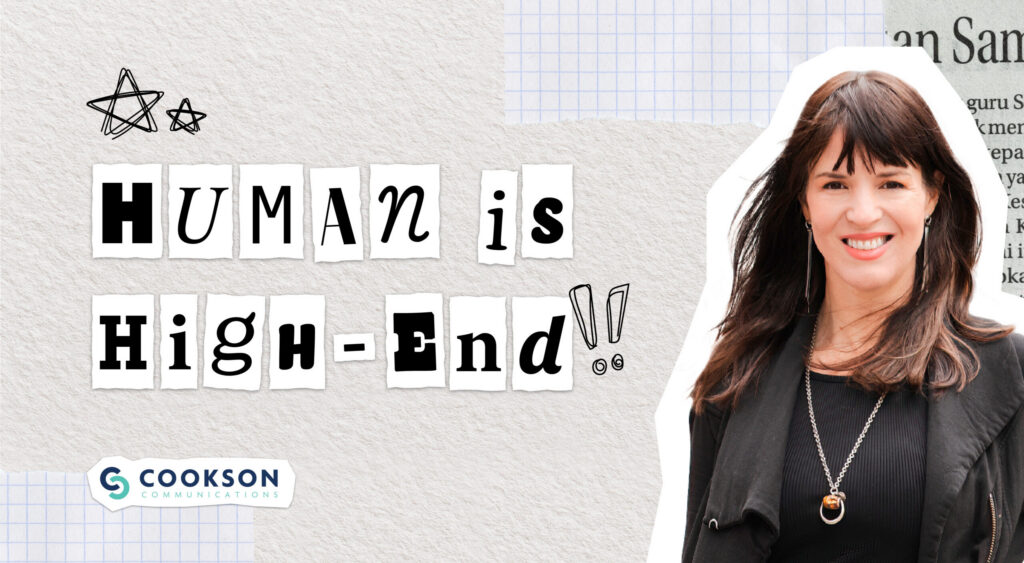
I’ll leave you with this: Human is the new high-end. And when it comes to design, I’d rather be high-end than AI-generated, and I’ll remain that way until Steven Spielberg (“AI: Artificial Intelligence”, 2001) can convince me otherwise.
* TBH scrapbooking requires a pretty big commitment and decent design skills.